

Haryanas Proposed 264 FAR: What Can You Actually Build on Your Plot?
Summary
Haryana’s proposed 264% FAR could change how much some plot owners build. Here is how to understand the figures, potential charges, court proceedings and approvals before making plans. A headline saying a residential plot could get 264% floor area ratio may sound like permission to build more immediately. For a Haryana plot owner planning a new home or reconstruction, the useful question is more specific: how much of that area would be available for this plot, at what cost, and under which approvals? The answer is not settled yet.
Published on
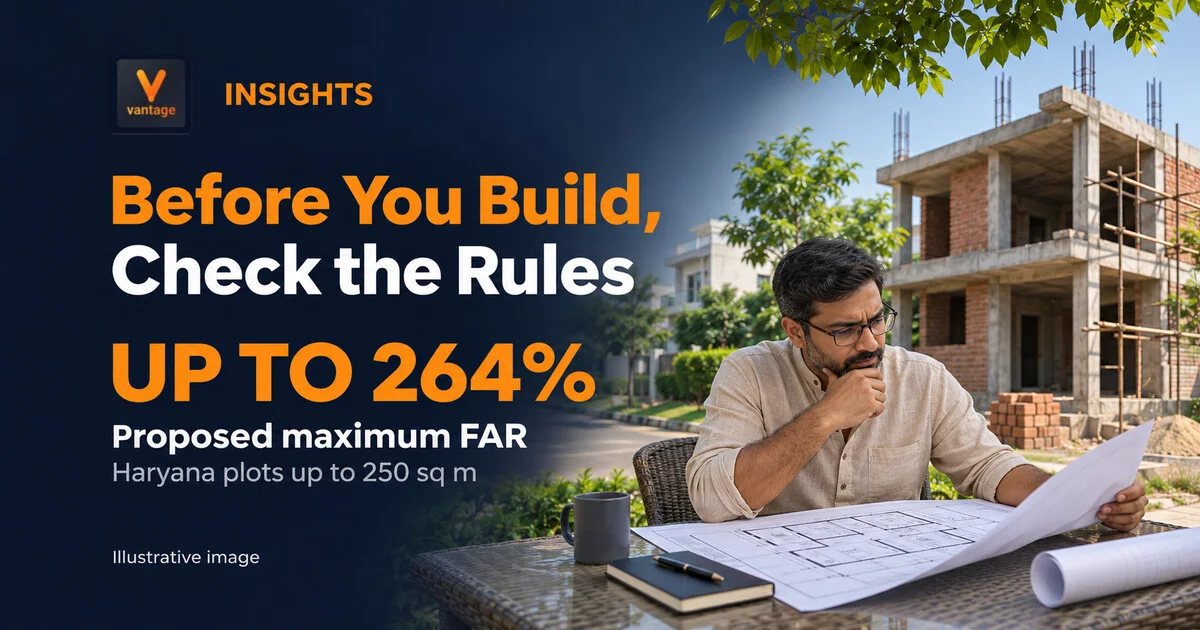
An illustrative Vantage InSights banner highlights the proposed maximum FAR of 264% for Haryana residential plots up to 250 square metres. The hook, “Before You Build, Check the Rules,” reflects the article’s focus on approvals, charges and applicable building conditions.
A headline saying a residential plot could get 264% floor area ratio may sound like permission to build more immediately. For a Haryana plot owner planning a new home or reconstruction, the useful question is more specific: how much of that area would be available for this plot, at what cost, and under which approvals?
The answer is not settled yet. Haryana has proposed changes to the Haryana Building Code, 2017, and invited public feedback. The final provisions, any purchasable FAR charges and applicable court directions need to be checked before using the proposed maximum in a construction budget.
The Tribune reports that the proposed 264% maximum applies to residential plots up to 250 square metres. Larger plots in the reported categories, up to 1,000 square metres, have a proposed maximum of 240% -> Haryana proposes higher FAR for residential plots up to 1,000 sq m; caps building height at 16.5 m.
What does FAR mean for a homeowner?
Floor area ratio, or FAR, expresses the floor area counted under the applicable rules as a proportion of plot area. It is a planning measure, not the same thing as the carpet area inside a flat.
Take a hypothetical 200-square-metre plot. Based on the reported proposal, it falls in the category above 100 and up to 250 square metres:
- Proposed base FAR of 145%: 200 × 1.45 = 290 square metres of floor area.
- Proposed maximum FAR of 264%: 200 × 2.64 = 528 square metres of floor area.
- Difference between those figures: 238 square metres.
This is a mathematical illustration, not a sanctioned building plan. It does not establish that the full difference can be built, how much it would cost, or which spaces count toward FAR. Those answers depend on the final rules, purchasable FAR provisions, design constraints and the competent authority's approval.
Is the extra area free?
Do not assume so. ETRealty reports that the proposed maximum includes additional purchasable FAR. That means the headline maximum and the base FAR should be examined separately.
For a plot owner, the decision is not simply whether more area is theoretically available. It is whether the additional area can be approved and whether its potential use justifies the applicable charges and construction costs.
Read the reported proposal and example for a larger plot here -> Haryana proposes FAR up to 264% for residential plots, S+4 height limit.
Before comparing quotations, ask the relevant authority and a qualified local architect for the applicable FAR calculation, charges, setbacks, parking and other conditions. Do not treat a verbal estimate as a final approval.
Does higher FAR mean another floor is guaranteed?
No. Total permitted floor area and the number of floors are related but separate questions. The Tribune reports a proposed maximum height of 16.5 metres, including specified ground-plus-three and stilt-plus-four configurations. A site's permissible design also depends on other conditions and any applicable court directions.
The legal position deserves particular attention in Gurugram. Bar & Bench reported on 4 November that the Punjab and Haryana High Court expressed reservations about purchasable FAR and was considering whether to stay its implementation. The report does not establish that the court had already imposed that additional stay.
The same report notes an earlier stay on implementation of the stilt-plus-four policy in Gurugram -> Purchasable FAR destroying Gurugram, Noida: P&H High Court moots stay in Haryana.
A Haryana RERA project record describes the earlier interim order as clarified to apply to Gurugram district and prospective in nature. It also records that the wider policy remains subject to the petition's final outcome. These are facts recorded in a particular regulatory matter; the effect on any other property depends on its own documents and the latest directions -> Haryana RERA project record.
What should buyers and neighbours consider?
A prospective buyer of an independent floor should ask for the latest sanctioned plans and verify that the floor being offered matches the approvals. A proposal to allow more construction does not establish that a particular advertised floor is sanctioned.
Neighbours may welcome more housing choices but also want to understand the effect of additional occupancy on parking, water, drainage and access. The High Court's reported concerns included parking and urban infrastructure. The proposal itself does not establish the impact on any individual neighbourhood.
If you already have an approved plan or have purchased a floor, do not assume the proposal changes your existing rights or obligations. Ask the competent authority and a qualified professional to assess your documents against the latest applicable orders.
What to check next
- Confirm the plot category. Check the plot area and its recorded units in your ownership and planning documents. A plot just above 250 square metres falls in a different reported category from one at or below that threshold.
- Check the final rules and charges. Ask the relevant planning authority whether the proposal has been notified, what FAR is applicable to the site and whether additional FAR is available and payable.
- Review the current legal and approval position. For a proposed stilt-plus-four building, particularly in Gurugram, ask a qualified local professional to check the latest court directions and obtain written confirmation from the competent authority.
- Compare the cost with the intended use. If extra FAR is available, compare the authority's charges, design and construction estimates, financing costs and the practical use of the space before committing to a plan.
FAQ
Is 264% FAR already available to every Haryana plot owner?
No. It is a reported proposed maximum for specified residential plot sizes. Its final status and application to an individual site need confirmation.
Which plots have a proposed maximum of 264%?
The Tribune reports that the proposed maximum applies to the two categories covering plots up to 250 square metres. The proposed base FAR differs between plots up to 100 square metres and those above 100 up to 250 square metres.
What is the difference between base FAR and maximum FAR?
The base is the starting FAR figure in the reported proposal. The maximum includes additional purchasable FAR, subject to the applicable conditions and charges.
Does 264% FAR mean I can cover 264% of my plot on the ground?
No. FAR concerns counted floor area relative to plot area across the building. Ground coverage is a different measure concerning the portion of the plot covered at ground level.
Does the proposal automatically permit stilt-plus-four construction?
No. The proposal, applicable height and planning conditions, site-specific permissions and relevant court directions must be considered together.
When can the public submit suggestions?
The Tribune reports a deadline of 1 December 2026. Check the original notice or the relevant department for the submission method and any later change to the deadline.
Can a buyer rely on an advertisement saying a fourth floor is allowed?
An advertisement is not a substitute for the latest sanctioned plans and applicable approvals. Ask for the relevant documents and have them reviewed for the specific property.
Sources
Click an article title to view the source.
- Haryana proposes higher FAR for residential plots up to 1,000 sq m; caps building height at 16.5 m, updated on 3 November 2026 in The Tribune.
- Haryana proposes FAR up to 264% for residential plots, S+4 height limit, published on 6 November 2026 in ETRealty.
- Purchasable FAR destroying Gurugram, Noida: P&H High Court moots stay in Haryana, published on 4 November 2026 in Bar & Bench.
- Haryana RERA project record, inspected on 6 November 2026 on the Haryana RERA website.
Evidence Caveats
The November proposal and feedback deadline are based on news reporting. The original draft notice, final amendment and a schedule of applicable purchasable FAR charges were not independently inspected. The latest court order was not obtained for this article; the court discussion is based on the cited legal report and an official RERA project record. That record is project-specific. The hypothetical calculation does not account for design restrictions, exclusions or costs.
If you were planning a home on a Haryana plot, which would matter most to you: extra floor space, the cost of obtaining it or the effect on local infrastructure? Share your reasoning or a question in the attached forum discussion. Different experiences and views are welcome.
Disclaimer
This article provides general information, not legal, financial, architectural or engineering advice. Rules and approvals depend on the property and may change. Consult the competent authority and qualified professionals before making a property or construction decision.

From TatvaOps
Residential Construction
Building or extending your home?
Run your residential build with verified contractors and daily progress tracking.
Free quotes · Verified contractors · tatvaops.com
Discuss this article
Join the conversation
Continue this discussion on Forums. A board named like this InSights article is filed under InSights.
1 reply already on Forums
More from Construction
Supertech Homebuyers: What NBCCs 9,600 Crore Work-Award Target Means for Your Project
NBCC expects to award Supertech project work this quarter. For buyers awaiting possession, the key questions are which package covers their home, who will build it and what the project-specific schedule says.
Cyclone Murasu: Check Safety Before Planning Repairs
After Cyclone Murasu’s reported landfall, a quieter sky does not establish that a property is safe. Follow local return instructions, obtain qualified assessments and define the repair scope before committing to restoration work.
Free Flow Tolling What Highway Users Should Check
How drivers can prepare their FASTag and review transactions as barrier-less tolling expands.
Key Insight Actions
Connected knowledge for Construction Regulations
Move between tutorials, discussions, Studio, and hubs without losing context.
Conclusion Intelligence
Was this helpful?
Let us know what you think