

India Gold Imports: UAE Gains as Switzerland Loses Share
Summary
India's gold import supply chain is undergoing a significant change as domestic refiners increase purchases of semi refined metal and trade incentives make alternative sourcing routes more attractive. Switzerland's share of India's bullion imports declined from 42.4% to 21.9% between fiscal 2021 and fiscal 2026, while the United Arab Emirates increased its share from 10.8% to 16.5%, according to Crisil Intelligence figures reported by The Economic Times on 26 October 2026. The change reflects growing domestic refining capacity, preferential tariff arrangements and attempts to diversify the country's gold supply.
Published on
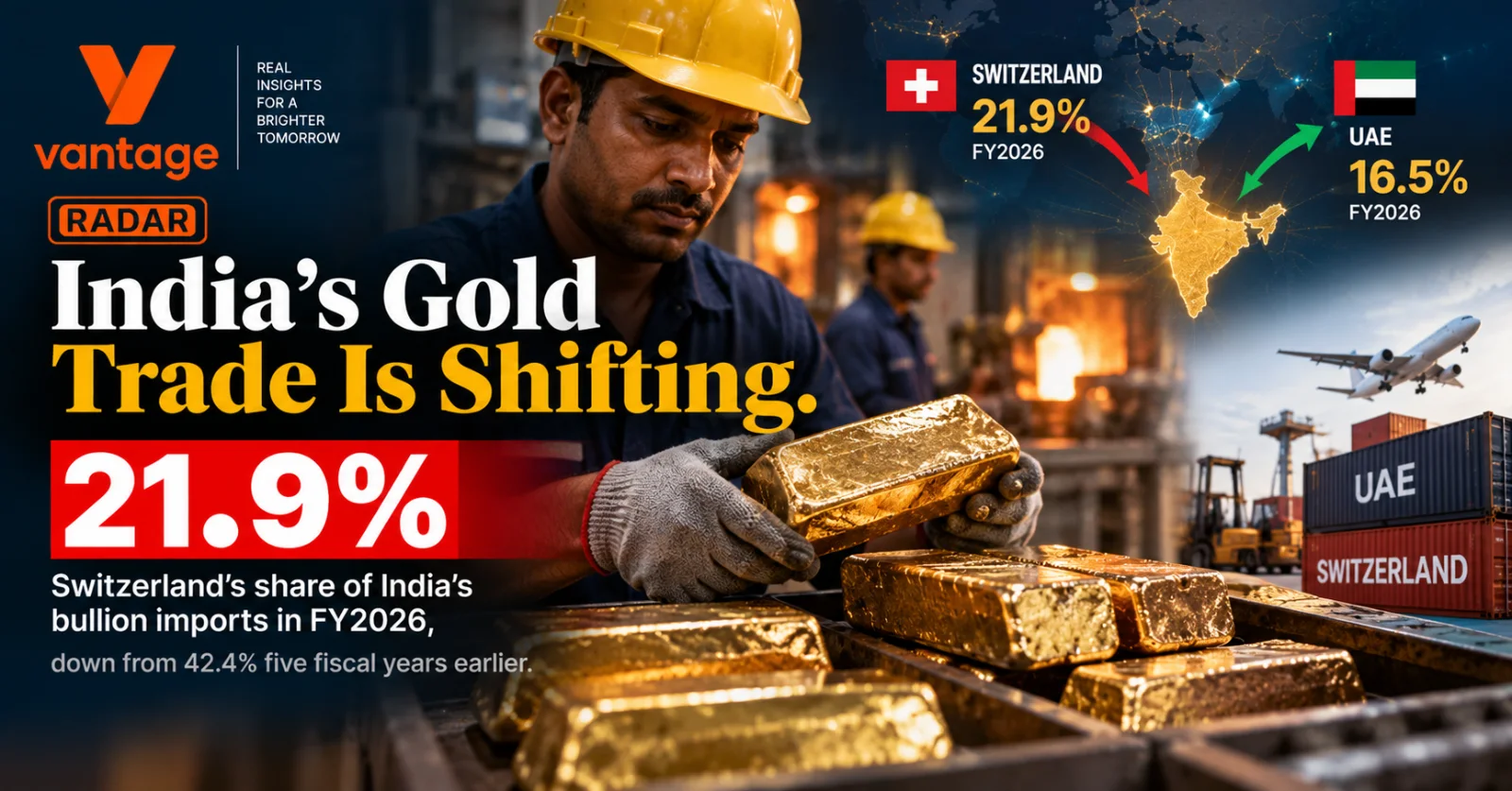
India's gold import supply chain is shifting as Switzerland's share of bullion imports falls to 21.9% in FY2026, while the UAE gains importance. The visual highlights gold refining, international trade routes and India's efforts to diversify gold sourcing.
India's gold-import supply chain is undergoing a significant change as domestic refiners increase purchases of semi-refined metal and trade incentives make alternative sourcing routes more attractive.
Switzerland's share of India's bullion imports declined from 42.4% to 21.9% between fiscal 2021 and fiscal 2026, while the United Arab Emirates increased its share from 10.8% to 16.5%, according to Crisil Intelligence figures reported by The Economic Times on 26 October 2026.
The change reflects growing domestic refining capacity, preferential tariff arrangements and attempts to diversify the country's gold supply.
It also raises an important question: will a more competitive gold-import system translate into meaningful benefits for India's jewellery industry?
Why Is India Buying Less Gold from Switzerland?
Switzerland has traditionally been an important supplier of refined gold bullion to India.
Its internationally established refining industry produces high-purity bullion suitable for wholesale trading, manufacturing and investment markets.
But importing finished gold bars is not the only way to meet domestic demand.
Indian refiners can also purchase gold doré, a semi-refined product that is processed further to obtain high-purity gold.
As refining capacity develops, these businesses can increasingly source doré from mining-linked suppliers rather than relying entirely on established international refining hubs.
According to The Economic Times' 26 October report, growing imports of doré from countries including Ghana, Chile and Peru have contributed to this diversification.
The reported decline in Switzerland's share does not mean India has stopped importing Swiss gold.
It means Switzerland accounts for a smaller proportion of the overall import basket than it did five years earlier.
How Has the UAE Become More Important?
The India-UAE Comprehensive Economic Partnership Agreement (CEPA), implemented in May 2022, provides a preferential trade framework for eligible gold imports.
Under the applicable tariff-rate quota arrangements described in the Economic Times report, qualifying UAE gold imports receive a one-percentage-point customs duty advantage over the standard rate.
Following India's May 2026 duty increase, the report identifies the standard import duty on finished bullion as 15% and the corresponding preferential rate for qualifying UAE imports as 14%.
This difference can influence sourcing decisions for importers able to satisfy the agreement's eligibility and origin requirements.
The report also cites Global Trade Research Initiative figures showing that gold imports from the UAE reached $649.4 million in June 2026, compared with $235.9 million in June 2025.
However, the UAE's growing role has prompted questions about rules of origin.
The Global Trade Research Initiative has expressed concern that gold may sometimes be routed through trading hubs to benefit from tariff preferences without substantial value addition in the exporting country.
That concern represents the research organisation's assessment, not an established finding of regulatory non-compliance across all UAE gold shipments.
Why Does Gold Doré Matter?
Gold doré is not the same as investment-grade refined bullion.
Doré generally contains gold alongside silver and other materials that must be separated or processed.
Domestic refiners purchase this material, refine it and supply high-purity gold for downstream markets.
India's tariff structure offers eligible doré imports a 0.65-percentage-point duty advantage compared with finished bullion, according to the Economic Times report.
This creates an incentive for domestic refining, although the commercial benefit depends on processing costs, recovery rates, logistics and the availability of suitable material.
An expanding domestic refining industry may help retain more processing activity within India.
Yet increased refining capacity alone does not establish that the country can immediately replace all imported finished bullion.
Refining quality, scale, financing and access to international trading networks remain important constraints.
What Do Official Trade Figures Show?
The government's Directorate General of Commercial Intelligence and Statistics published country-wise data for the October-December 2025 quarter.
Its report recorded the following shares of India's gold import value:
- Switzerland: 22.86%
- UAE: 22.21%
- Peru: 9.37%
- Ghana: 8.87%
- Hong Kong: 6.10%
The figures show that Switzerland and the UAE were nearly equal suppliers during that particular quarter.
They should not be confused with Crisil Intelligence's full-fiscal-year estimates for FY2026.
Different time periods can produce different sourcing shares, particularly when gold prices, import volumes and trade routes change significantly.
The official quarterly figures nevertheless reinforce the observation that India's gold supply is no longer overwhelmingly dependent on one trading centre.
Could This Make Gold Cheaper in India?
A more efficient supply chain may improve procurement economics for some importers and refiners.
Lower qualifying duties, better sourcing arrangements and domestic value addition can influence wholesale costs.
But lower procurement costs do not automatically translate into lower retail jewellery prices.
Indian gold prices are also influenced by international bullion prices, the rupee-dollar exchange rate, customs duties, applicable taxes and local market conditions.
Jewellery purchases carry additional considerations such as making charges, purity, retailer margins and other transaction costs.
Therefore, a change in gold-import routes does not establish that jewellery or investment gold has become cheaper for consumers.
What Does This Mean for India's Economy?
Gold imports are relevant not only to households and jewellery businesses but also to India's external trade accounts.
India relies heavily on international gold supplies to meet domestic demand.
A higher import bill can add to the merchandise trade deficit, while currency movements may increase the rupee cost of imported metal.
A stronger domestic refining ecosystem may increase local processing activity and potentially improve supply-chain resilience.
However, refining imported gold within India does not remove the country's dependence on overseas gold resources.
The eventual economic benefit depends on the amount of domestic value added, processing efficiency and the overall trade arrangements.
What Happens Next?
Several developments will help determine the long-term impact of India's changing gold supply chain.
The first is whether domestic refiners expand their ability to source and process doré competitively.
The second is how the India-UAE trade agreement's gold-import preferences operate as quota arrangements evolve.
The third is whether regulators strengthen origin verification while maintaining legitimate trade benefits.
The larger question is whether the diversification produces a more transparent, resilient and cost-efficient supply chain.
India's gold imports are changing geographically, but the ultimate benefits will depend on what happens between international sourcing and the final customer.
Should India prioritise expanding domestic gold refining or reducing reliance on preferential trade routes? Share your reasoning and relevant evidence in the attached forum discussion.
Sources
Click an article title to view the source.
- India's gold import route changing course for a benefit all jewellers want, published on 26 October 2026 in The Economic Times.
- India's gold rush takes a Dubai detour as UAE shipments soar while rest of world imports fall, published on 2 September 2026 in The Economic Times.
- Quarterly Review of Merchandise Foreign Trade: October-December 2025, published in March 2026 by the Directorate General of Commercial Intelligence and Statistics, Government of India.
- Trade Watch: October-December FY2025-26, published in 2026 by NITI Aayog.

From TatvaOps
Farm Infrastructure & Self-Sustainability
Financing your project?
Explore credit and milestone-secured payment options with Tatva Finance.
Free quotes · Verified contractors · tatvaops.com
Discuss this article
Join the conversation
Continue this discussion on Forums. A board named like this Radar article is filed under Radar.
More from Construction
Noida Metro Extension to Greater Noida Sector 4 Approved
The Union Cabinet has approved an extension of the Noida Metro Aqua Line from Noida Sector 51 to Greater Noida Sector 4, advancing a proposed connection for residents and commuters in Greater Noida West. The approved corridor is planned to cover 8.449 kilometres and include five elevated stations ,…
Bengaluru Metro Blue Line Trial Reaches Doddanekundi: What Happens Next?
A trial train on Bengaluru Metro’s proposed Blue Line reached Doddanekundi on 10 November, marking progress in testing along the city’s Outer Ring Road corridor. The movement took place from the Baiyappanahalli depot to Doddanekundi Metro station, according to a Moneycontrol report. An earlier…
RBI Rejects Claim That All Existing Cheque Books Must Be Replaced in 2027
The Reserve Bank of India has rejected a circulating claim that existing standard Cheque Truncation System cheque books must be replaced because new security standards will take effect from 1 January 2027. The clarification addresses a purported nationwide RBI change . Customers should still check…
Key Insight Actions
Connected knowledge for Gold Trade
Move between tutorials, discussions, Studio, and hubs without losing context.
Conclusion Intelligence
Was this helpful?
Let us know what you think