

Gujarat Solar Subsidy Top-Up: What Households Pay
Summary
Detailed breakdown of Gujarats residential rooftop solar top up subsidy, net consumer outlays, and eight month payback economics. Residential rooftop solar in India has long faced an adoption paradox. While central financial assistance under the PM Surya Ghar Muft Bijli Yojana offers up to Rs 78,000 in capital support, households in western India still face substantial out of pocket costs for rooftop structural mounting, balance of system hardware, and net metering setup. The Government of Gujarat resolved that barrier through Government Resolution EPCD/BUD/e file/20/2025/2435/B1, issued on October 22, 2026.
Published on
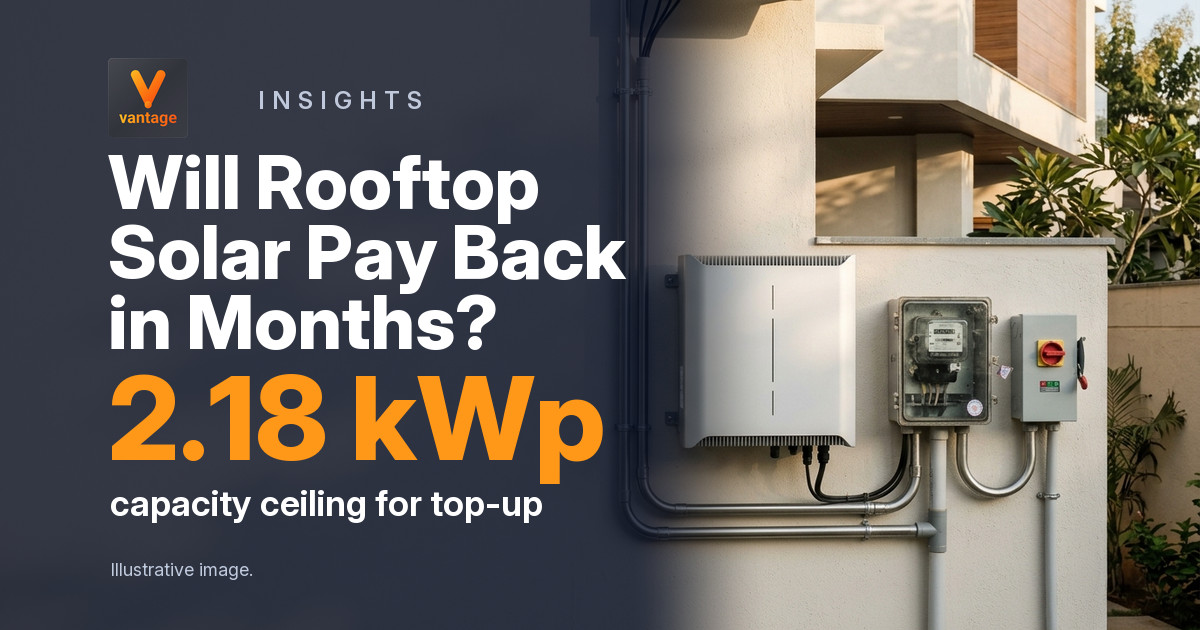
Residential hybrid solar inverter and electrical disconnect on home exterior wall reflecting net-metering economics under PM Surya Ghar
Credit: Illustrative image
Inline Intelligence
Residential rooftop solar in India has long faced an adoption paradox. While central financial assistance under the PM Surya Ghar Muft Bijli Yojana offers up to Rs 78,000 in capital support, households in western India still face substantial out-of-pocket costs for rooftop structural mounting, balance-of-system hardware, and net-metering setup.
The Government of Gujarat resolved that barrier through Government Resolution EPCD/BUD/e-file/20/2025/2435/B1, issued on October 22, 2026. By capping the consumer financial contribution at 10 percent of benchmark system costs for general residential consumers and 5 percent for Scheduled Caste and Scheduled Tribe families, Gujarat established the country's most affordable residential solar framework.
For homeowners with suitable rooftop space, this policy change transforms the payback math from a multi-year capital commitment into a low-risk household upgrade.
How the State Top-Up Mechanism Functions
Under the national PM Surya Ghar framework, the Central Government provides fixed Central Financial Assistance:
- 1 kW System: Rs 30,000 central subsidy.
- 2 kW System: Rs 60,000 central subsidy.
- 3 kW System and above: Capped at Rs 78,000.
In Gujarat, the benchmark installation cost for a 2 kW residential system typically ranges between Rs 1,00,000 and Rs 1,10,000 depending on module efficiency and mounting structures. Previously, after deducting the Rs 60,000 central subsidy, the homeowner needed to finance between Rs 40,000 and Rs 50,000 from personal savings or bank loans.
Under the October 22 resolution, the state framework establishes a maximum capacity ceiling of 2.18 kWp. For qualifying systems:
- General Consumers: Required to contribute exactly 10 percent of the benchmark cost.
- SC and ST Households: Required to contribute exactly 5 percent of the benchmark cost.
- State Fiscal Transfer: The Gujarat government disburses the intermediate gap directly to state DISCOMs (Uttar Gujarat Vij, Dakshin Gujarat Vij, Madhya Gujarat Vij, and Paschim Gujarat Vij) through direct benefit transfers once the installation passes commissioning inspection.
Rooftop Viability and Grid Net-Metering
While capital cost barriers have dropped, technical feasibility remains essential. The state policy requires installations to connect through bi-directional net meters. Surplus daytime solar electricity feeds into the regional grid at prescribed feed-in tariffs, offsetting evening domestic consumption.
Homeowners whose sanctioned electrical load is less than their desired solar capacity must apply for a load enhancement before commissioning. Furthermore, the 2.18 kWp capacity cap means households requiring larger arrays must evaluate whether installing a 2 kW system with maximum subsidy yields a better return on equity than a larger unsubsidized 5 kW array.
What Gujarat Homeowners Can Do Now
Prospective solar adopters and residential property owners should review their electricity billing profiles, roof geometry, and documentation before engaging empaneled vendors.
Risk Metrics and Screening Parameters
- Sanctioned Connected Load: Verify that your connected electrical load on your monthly electricity bill is at least equal to your proposed solar capacity. A 2 kW plant requires at least a 2 kW sanctioned load.
- Usable Roof Area: A standard 1 kW array requires approximately 100 square feet of shadow-free terrace space. A 2 kW system requires roughly 200 square feet facing south or south-southwest.
- Consumer Share Threshold: Ensure vendor quotation out-of-pocket figures do not exceed 10 percent of the DISCOM benchmark (or 5 percent for SC and ST beneficiaries).
Action Checklist
- Verify Vendor Empanelment: Visit the National Portal for Rooftop Solar (pmsuryaghar.gov.in) and confirm that your contractor is listed under the official roster for your specific DISCOM (such as MGVCL or UGVCL).
- Download Benchmark Cost Schedules: Access your DISCOM circular portal and download the approved benchmark schedule under G.R. No. EPCD/BUD/e-file/20/2025/2435/B1.
- Submit National Portal Registration: Register your consumer service number on the PM Surya Ghar portal before signing any private contractor agreements.
- Verify Caste Certificate (If Applicable): SC and ST beneficiaries must keep valid digital caste certificates ready for portal verification to unlock the 5 percent contribution rate.
- Inspect Net-Meter Commissioning Report: After physical installation, ensure the DISCOM inspector issues a signed Joint Commissioning Report (JCR) and bi-directional meter programming confirmation.
Decision Rules for Common Situations
- If your monthly consumption is below 250 units: Install a 2 kW system under the 2.18 kWp top-up cap. Your out-of-pocket expenditure is limited to roughly Rs 10,000, and your monthly electric bill will drop near zero.
- If your monthly consumption exceeds 500 units: Evaluate whether to install a 2.18 kWp system with maximum state subsidy, or opt for a 4 kW array where capacity above 3 kW receives no additional top-up. For most villas, the 2.18 kWp system yields the fastest capital payback.
Worked Example: Financial Payback for a 2 kW Ahmedabad Home
Consider a middle-class residential household in Ahmedabad consuming 220 units of electricity per month at an average tariff of Rs 6.20 per unit:
- Annual Electricity Cost: 220 units multiplied by 12 months at Rs 6.20 equals Rs 16,368 per year.
- Total Benchmark System Cost: Rs 1,02,000 for a 2 kW monocrystalline rooftop setup.
- Central Subsidy (CFA): Rs 60,000 credited under PM Surya Ghar.
- Gujarat State Top-Up Subsidy: Rs 31,800 paid directly by state government.
- Net Out-of-Pocket Cost for Homeowner: Exactly 10 percent of benchmark, which is Rs 10,200.
- Annual Solar Generation: A 2 kW system generates approximately 2,800 units per year in Gujarat's high-solar insolation climate.
- Annual Electricity Bill Savings: Rs 16,368 in avoided power bills plus small feed-in export credits.
- Financial Payback Period: The net investment of Rs 10,200 is fully recovered in less than 8 months of domestic utility bill savings.
Signals to Monitor
- DISCOM quota updates on the PM Surya Ghar portal.
- State budget allocations for renewable energy top-up transfers.
- Local power distribution net-metering processing timelines.
FAQ
Can I get the 10 percent cap if I install a 5 kW solar plant? No. The Gujarat Government Resolution specifically restricts the state top-up subsidy to residential systems up to 2.18 kWp. Larger systems receive the standard central CFA capped at Rs 78,000 without the state top-up.
Do apartment owners in housing societies qualify individually? Individual apartment owners can install rooftop solar if they own private terrace rights. Housing societies installing common-area solar systems receive central subsidies under the Group Housing Society scheme at Rs 18,000 per kW up to 500 kW, but fall under a separate commercial circular.
How is the state subsidy disbursed to the homeowner? The homeowner pays only the net contribution (10 percent or 5 percent) to the empaneled vendor, while central and state subsidies are settled directly with the vendor and DISCOM through DBT upon joint inspection.
Sources
- Government of Gujarat Energy and Petrochemicals Department: Government Resolution No. EPCD/BUD/e-file/20/2025/2435/B1, October 22, 2026.
- Madhya Gujarat Vij Company Limited (MGVCL): Circulars and Orders for PM Surya Ghar Residential Rooftop Solar, October 2026.
- Ministry of New and Renewable Energy: PM Surya Ghar Muft Bijli Yojana Operational Guidelines.
Evidence Caveats
This analysis is based on Gujarat Government Resolution EPCD/BUD/e-file/20/2025/2435/B1 issued on October 22, 2026. Actual quotation prices may vary slightly based on roof elevation, specialized elevated mounting structures, and custom wiring lengths. Power generation figures depend on terrace shadow-free exposure and seasonal weather patterns.
Join the conversation on the Vantage forum: What is your estimated payback period for residential rooftop solar in Gujarat?
Disclaimer
This article is published for educational and informational purposes only and does not constitute technical, engineering, or financial advice. Homeowners should consult certified solar vendors and review local DISCOM regulations before contracting rooftop installations.

From TatvaOps
Solar & Energy Solutions
Considering rooftop solar?
Verified installers, subsidy support, and milestone-secured payments.
Free quotes · Verified contractors · tatvaops.com
Discuss this article
Join the conversation
Continue this discussion on Forums. A board named like this InSights article is filed under InSights.
More from Solar
Telangana Open Access: What Will Your Power Cost?
Telangana’s higher open-access surcharge can narrow renewable power savings. Check which units attract the charge, who pays it under your contract and what it does to your delivered cost.
Delhis Free Rooftop Solar: Does Your Home Qualify?
Does your Delhi home qualify for zero-upfront-cost rooftop solar? Check how the 400-unit average is calculated, whether your roof can be used, and who handles maintenance after five years.
Renewable Energy Land Risk: What Investors Should Check
A renewable-energy pipeline is only as credible as its execution assumptions. Check land readiness, permissions, grid dependencies and funding before treating announced capacity as future operating income.
Inline Intelligence
Key Insight Actions
Connected knowledge for Investment Guides
Move between tutorials, discussions, Studio, and hubs without losing context.
Related discussions
Topic hubs
Conclusion Intelligence
Related Discussions
Was this helpful?
Let us know what you think